Museum Photo Gallery

Time-line index to Museum exhibits by century and decade

Click on a decade below to jump to information and photographs of the equipment the Museum has on display for that decade and then click on exhibit title to view a full description of the item and and image which can be enlarged.
        Pre 1849
1800's   Decades   1851 - 1860 | 1861 - 1870 | 1871 - 1880 | 1881 - 1890 | 1891 - 1900
1900's   Decades   1901 - 1910 | 1911 - 1920 | 1921 - 1930 | 1931 - 1940 | 1941 - 1950

1951 - 1960 | 1961 - 1970 | 1971 - 1980 | 1981 - 1990 | 1991 - 2000
2000's   Decades   Post 2000
Pre-1849
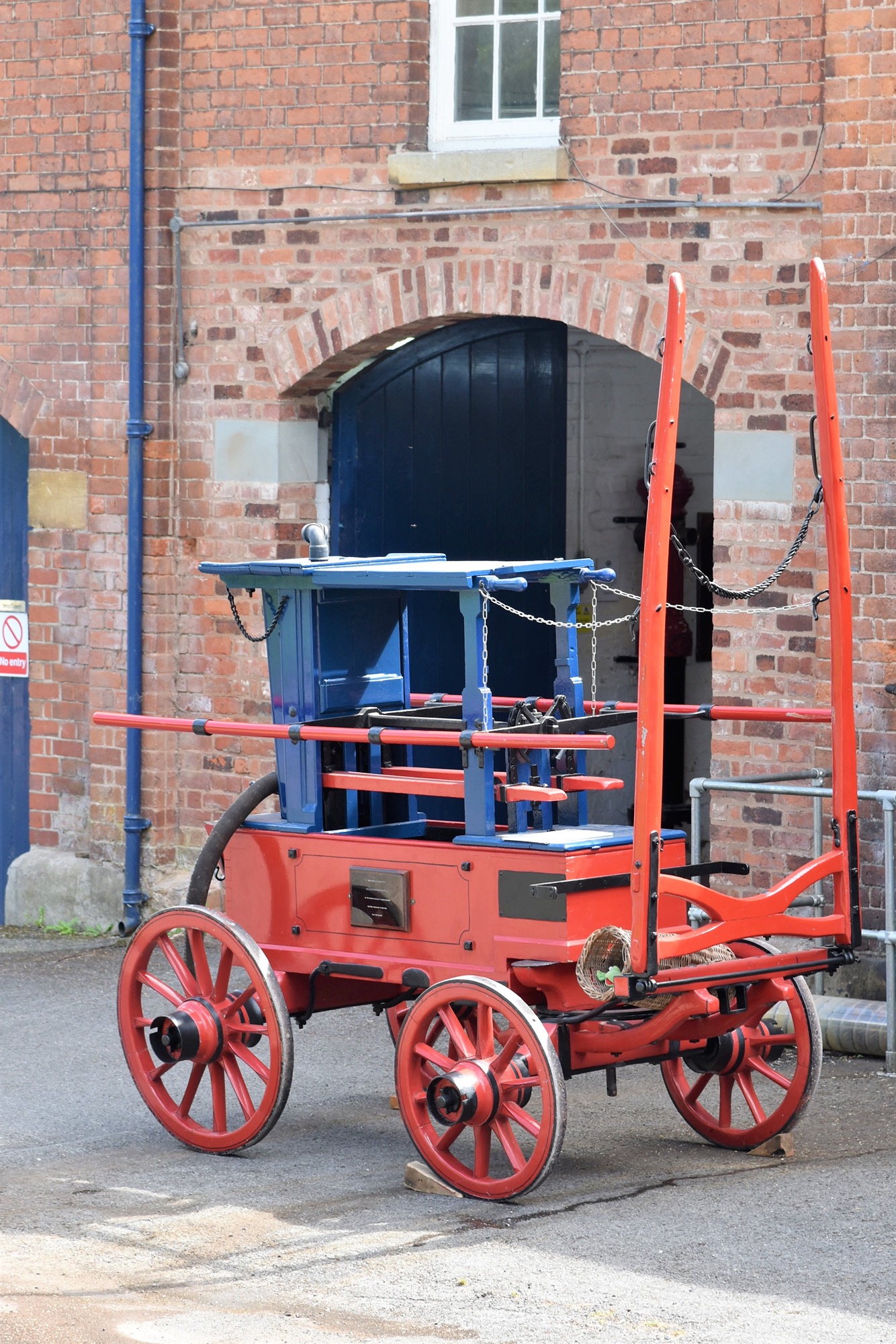
Horse Drawn Fire Engine - (1805)
Horse Drawn Fire Engine Hadley, Simpson & Locke
Water is delivered from a 2-cylinder pump operated by the handles on both sides and the treadles in front. Special features are the use of leather for the inlet and discharge hoses and the wicker-work strainer when drawing water from a pond. Used at Stoke Lacy House, Herefordshire.
Water tank capacity: 270 litres(60 gallons) Pump power: Maximum 13 firemen (six each side plus the driver) On long loan from Herefordshire Heritage Service.
More information
1850
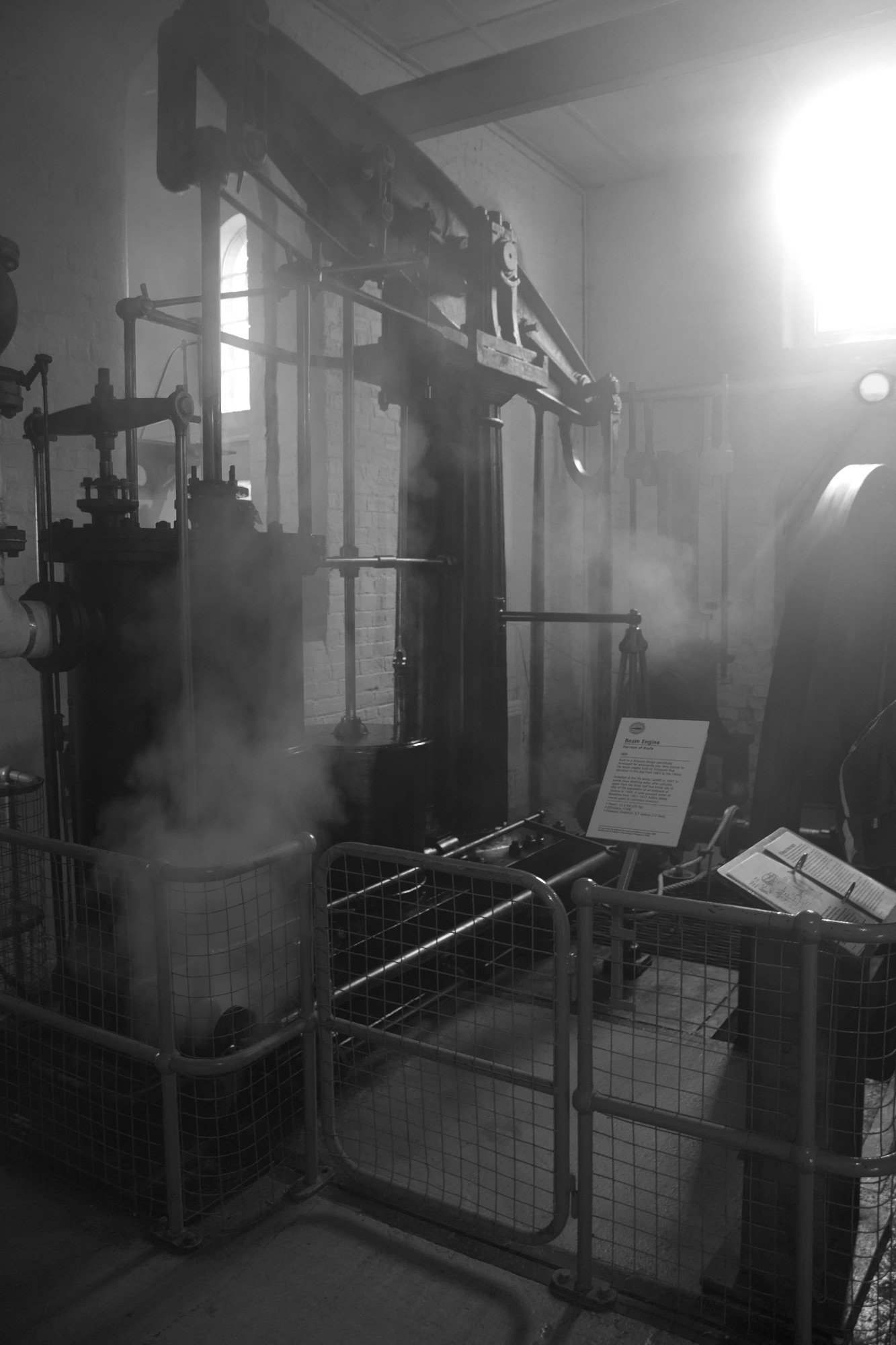
Simpson Beam Engine - (1851)
Harvey’s of Hayle, Cornwall. Built to a Simpson design specifically developed for waterworks use. Originally installed at Ely Wells, Cardiff in 1851 to pump clean water after polluted water from the River Taff had killed one in fifty of the population in an outbreak of cholera in 1850. Later pumped water at Rhiwbina before being moved again to Llanishen reservoir. This example is of the same make, size and type as the original which stood in this position at Hereford. Power: 15.2kW (20hp) Flywheel diameter: 3.7 metres (12 feet) On long loan from the National Museums & Galleries of Wales
More information
Guest & Grimes water level instrument - (1856)
Original water-level indicator on site (1856), installed to monitor the level of water in the sump below the building from which the first beam engine pumped water. A float on the water surface connects by cord to a drum mechanism which actuates the indicating needle through gearing. The sump is supplied by water through deep conduits from the River Wye. As the sump is gravity fed the height of water in the sump is the same as the height of the river.
More information
Museum main building; 1856-1906 - (1856)
Museum main building; Hereford’s Victorian water-pumping station The Hereford Improvement Act of 1854 gave the City Council permission to pave the streets of High Town (the central part of Hereford), install gas lighting, and to provide the citizens with piped, potable water. A site for the waterworks was chosen at Broomy Hill, about 1km upstream from the City centre on the River Wye. Two years later the initial works were complete with the water intake, pumping station and treatment works all constructed. The pumping station in 1856 comprised the boiler house and engine house with tall boiler chimney on the south side. As the demand for water increased, buildings were added progressively to the original construction. However, the municipal architecture was kept consistent and, apart from subtle differences in the brick colour, the whole building looks at first glance to have been constructed as a single entity. The final addition, an annexe at the west end, was built in 1906. The whole building is now Listed Grade 2 by English Heritage and is a Scheduled Monument. The Museum is designated a site of clear national importance.
More information
1860
Tangye House; ex-Leominster’s water-pumping station - 1865 - (1865)
Tangye House; ex-Leominster’s water-pumping station In the 1860s Leominster, an important market town in Herefordshire, endured several epidemics of typhoid fever from contaminated drinking water. Many of the more affluent traders had their own wells in their gardens but also cesspits. Poorer people took their water direct from the Pinsley Brook. The epidemics reached such a level of attrition amongst the adult population that the Government directed the Town Council to provide the townsfolk with piped, potable water. Money was raised through a Government loan by Mr Tertius Southall, a distant relation of the founder of the Waterworks Museum, Stephen Southall, and the waterworks building was constructed. It housed a steam engine and pump (later discarded with no records remaining) and was built above a known aquifer. Quite quickly the water level in the aquifer was brought too low to use and water was piped in from some distance. In 1990 the waterworks building was due to be razed to allow the extension of a business park in the town. The Museum negotiated with the developers, dismantled the building with the advice of Avoncroft Museum, and reconstructed it on the Waterworks Museum site. The roof support is of particular interest being an early wrought steel structure. The building is now called the Tangye House and is home to the 97litre Tangye horizontal diesel engine* and other displays.
More information
1870
Thorneycroft Reversing Two Cylinder Steam Engine. - (1878)
JI Thorneycroft & Co of Chiswick Inverted vertical compound steam engine, originally designed for the British Admiralty to power an early torpedo boat. Installed in Torpedo Boat TB53. Later installed in the river steamer ‘Beatrice’ plying the River Severn in Worcestershire. Three other similar engines survive but this is the only working example. Two cylinder; fully reversing valve gear Indicated horse power: 115 On long loan from Frank Barton of Hereford
More information
1880
Hayward-Tyler Rider type 1hp hot-air engine - (1880)
Hayward-Tyler & Co of Luton Installed originally at Taplow Lodge on the Cliveden Estate in Buckinghamshire, the engine was housed in a cellar and pumped water for the household and garden from a deep well. It was discovered in 1991 by the National Trust. Following recovery it was restored by local enthusiasts and re-commissioned in 1995. Until 2004 the engine was run once a year in Buckinghamshire. Probably the only hot-air engine of this size remaining in the UK. Engine No 583 rated at 1hp (largest size manufactured) Pumping capacity: 4.5kL (1000 gallons) from a well 46 metres (150 feet) deep per day On long loan from The National Trust
More information
Gilbert, Gilkes & Gordon double-vortex turbine - (1880)
Gilbert, Gilkes & Gordon Ltd (formerly Williamson Bros) of Kendal A rare example of a double-vortex turbine design patented by James Thompson in 1850. Originally installed at the Bryanston Estate near Blandford, Dorset, where it drove a 1.8 metre (6 foot) diameter circular saw in the estate saw mill. Peripheral inlet; double-axial discharge Quad guide-vane speed control Donated by Crown Estates
More information
Joseph Evans Reciprocating Pump - (1888)
Joseph Evans double-acting single-cylinder reciprocating pumps. Joseph Evans & Co of Wolverhampton Two pumps in the form of a handed pair originally driven by double-acting steam cylinders. Installed at Alton Court Waterworks, Ross-on-Wye, to lift water from boreholes to a closed reservoir above the town. In 1912 the steam cylinders were replaced by a National Gas engine*. Maximum duty: 41kL (9000 gallons) per hour Operating head: 55 metres (180 feet) Donated by Dwr Cymru Welsh Water.
More information
Warner Hydraulic Ram - (1889)
Warner hydraulic ram (plus other rams and hydrostat) Robert Warner & Co Hydraulic rams require no external source of power such as an engine or motor. They operate due to the inertia of the water flowing towards them. With a reasonably good head, a hydraulic ram can achieve an efficiency of some 12%. They are used extensively in the developing world and can still be found operating in rural Britain. The precursor of the ram was the pulsation engine of 1772 developed by John Whitehurst of Cheshire, but the first self-acting ram was invented by the Frenchman Joseph Mongolfier (of hot-air balloon fame) in 1796, with his friend Matthew Boulton taking out the British patent the same year on his behalf. The designs and patents were bought out by Josiah Easton of Somerset in 1820. In this summary lie the names of two of the key people who developed British engineering in the 19th century. The example on display was installed at Tedstone Court in Herefordshire to provide water for house and farm. No data available Donated by Major Belleville
More information
1890
Wilson-Hartnell Dynamo - (1890)
Wilson-Hartnell dynamo Wilson-Hartnell of Leeds Originally sited at the Refuse Destructor Works of Barry Urban District Council, Glamorgan, where it was driven by a Tangye steam engine. The dynamo provided power for the destructor works and a local school. At the Museum the dynamo is driven from the National Gas engine*. Output: 110V DC On long loan from the National Museums and Galleries of Wales.
More information
Hot Wire Voltometer - (1890)
The instrument makes measurements of voltage equally well on both AC and DC supplies. Its accuracy is independent of ambient temperature. This type of voltmeter was invented by Major Cardew in 1883. He was the first electrical adviser to the Board of Trade and devised the first set of Electricity Regulations. He established the Board of Trade electrical standards laboratory for the calibration of electricity meters. This instrument was formerly used at Burghill Hospital in Hereford.
More information
Doulton Candle-type Ceramic Water Filter - (1890)
A typical domestic water filter of the late Victorian period to remove harmful bacteria, such as those causing typhoid and cholera, from drinking water. Used mainly in country districts where no public water supply was available. The small inner container is fitted with five porous unglazed porcelain filter candles through which the impure water passes slowly, to be stored in the outer container. The candles can be unscrewed, brushed clean, and then sterilised by boiling. John Doulton founded Doulton & Watts Pottery in Lambeth. His son Henry joined the firm in 1835 bringing flair, innovation and new products including ceramic water filters. This example was formerly used at Tedstone Court near Bromyard in Herefordshire.
More information
Tangye Single-Cylinder Steam Engine - (1890)
Tangye single-cylinder horizontal steam engine (static exhibit) Tangye Ltd of Birmingham This single-cylinder horizontal steam engine was used at the Hereford Sanitary Laundry where it provided the power, via an overhead lay shaft and belts, for many different processes. It carries a large pulley wheel, with gracefully curved spokes, on the flywheel shaft, which would have been the power take-off for flat belting. The engine was rescued from a local scrapyard but unfortunately is incomplete so cannot be run. Its governor and auto cut-off mechanism are displayed in the Tangye House* adjacent. No data available Rescued by the Museum
More information
Hayward-Tyler Rider type ½ hp hot air engine - (1890)
Hayward-Tyler ‘Rider’ type ½hp hot air engine Hayward-Tyler Ltd of Luton Originally installed to power a borehole pump at Swainshill in Herefordshire. Hot-air engines work on the Stirling cycle and are not very efficient. However they require no boiler and can be fuelled by virtually anything combustible. Power rating: ½hp Water lift: 33 metres (110 feet) Donated by Mr J Robinson of Swainshill, Herefordshire
More information
Easton, Anderson & Goolden Turbine - (1890)
Easton, Anderson & Goolden horizontal turbine and triple-throw pumps Easton, Anderson & Goolden Ltd of Erith, Kent This firm operated from 1893 until 1901 but no date has been established for the pump-set. The system was installed at Caldecote Hall near Nuneaton to provide water for the hall and the estate. A horizontal water turbine of the Founeyron-type powers three reciprocating pumps through a pinion and crown wheel from the vertical shaft of the turbine to the pump crankshaft. Gear reduction: 2.5:1 Turbine input: 4546 litres per minute (1000 gallons per minute) Turbine speed: 160rpm Donated by Peter Keil
More information
Worth Mackenzie Triple-Expansion Steam Engine. - (1895)
Worth-McKenzie triple expansion steam engine Worth McKenzie Ltd of Stockton-on-Tees The oldest triple-expansion, double-acting, inverted, condensing steam engine still operating in the UK. Originally installed to draw raw water from the River Wye and deliver it to the treatment works on Broomy Hill behind the pumping station. Clean water descended from the treatment works to the high-pressure pumps, below the centre cylinder of the engine, for return to the water-tower tank. Three steam cylinders of increasing bore. Steam-heated cylinder jackets and valve chests. Meyer valve gear on the high pressure cylinder. Original steam pressure: 120 psi (8 atmospheres) Current steam pressure: 50 psi (3.3 atmospheres) Speed of rotation: 26 rpm Pumping capacity: 4.5 Mlitres (1 million gallons) per 12 hours In situ
More information
Campbell Hot Tube Gas Engine - (1895)
Campbell gas engine with hot-tube ignition The Campbell Gas Engine Co Ltd of Halifax Gas engines of this period were designed to run on producer gas in rural areas or coal gas in towns. Whichever gas was used it had to be ignited in the combustion chamber. For this purpose, heat from an external flame was conducted into the engine via a ceramic tube, known as the hot tube. This single-cylinder, horizontal engine was originally installed at Rhos-on-Sea, North Wales, as a donkey engine to provide compressed air for starting larger water-pumping engines. Engine No 4647 Bore: 127mm (5 inches) Stroke: 254mm (10 inches) Donated by Welsh Water
More information
Riley Brothers Lancashire Boiler - (1895)
Lancashire boiler Riley Brothers Ltd of Stockton-on-Tees Twin-flue, coal fired Lancashire-type boiler with Galloway tubes and water injector. Installed to provide steam for the Worth McKenzie triple-expansion steam engine*. Steam-operated water injector later replaced with a Worthington Simpson water feed pump*. Working pressure: 160 psi (11 atmospheres) Output: 907 kg/hour (2000 lb/hour) saturated steam Water capacity: 11364 litres (2500 gallons) In situ.
More information
1900
Glenfield & Kennedy Peebles-type sand washer - (1901)
Glenfield & Kennedy Ltd of Kilmarnock Portable machine for cleaning sand on building sites and most particularly at water treatment works. The soiled sand, which forms the top layer of a slow sand filter, is skimmed off and treated in the washer to clean and separate the sand according to grain size and detritus. Donated
More information
Glenfield & Kennedy Single Cylinder Double Acting Water Pump - (1905)
Glenfield & Kennedy double-acting reciprocating pump Glenfield & Kennedy Ltd of Kilmarnock Single-cylinder, double-acting, horizontal, open-crank water pump originally installed to provide drinking water for Aldeburgh in Suffolk. It completed service in 1970. The electric motor donated with the pump was not the original form of motive power which remains unknown. Bore: 203mm (8 inches) Stroke: 381mm (15 inches) Donated by the Museum of East Anglian Life, Stowmarket, Suffolk
More information
Worth McKenzie twin duplex steam engine - (1906)
Worth McKenzie twin duplex steam engine Worth McKenzie Ltd of Stockton-on-Tees Two-cylinder, inverted, vertical, condensing, steam engine. Both cylinders receive steam at full boiler pressure. The pistons act downwards to drive high-pressure pumps directly beneath them below floor level. This engine is probably the only one of its make and type operating in the world. Capacity: 81800 litres (18000 gallons) per hour Head: 57 metres (186 feet) In situ
More information
Overshot Waterwheel - (1907)
Overshot waterwheel made by the Eagle Foundry of Aberystwyth Eagle Foundry of Aberystwyth Originally installed at a farm in Dolaucothi in Carmarthenshire, to drive workshop machinery. The wheel was mounted at the end of a barn with the axle at ground level. Water from a stream was directed over the top of the wheel. A circumferential gear engaged with a pinion to power a lay shaft into the building. The wheel is now provided with pumped water in a closed circulation system. Wheel diameter: 4.3 metres (14 feet) On long loan from the National Museums and Galleries of Wales
More information
Kent Water-Flow Meter and Recorder - (1909)
Kent venturi water flow meter and recorder George Kent & Co Ltd of Luton and London Freestanding, weight-driven pendulum clock which includes a chart recorder to measure continuously the quantity of water per hour passing through a venturi meter. Used at Plasdulyn Water Treatment Works, Conwy Valley, North Wales. Maximum flow rate: 0.5 Mlitres (111,000 gallons) per hour Donated by Dwr Cymru Welsh Water
More information
1910
Fire Hydrant - (1910)
Fire hydrant Make unknown Little is known about this fire hydrant except that it was used at Rotherwas Camp, Hereford, from 1912 to 1914 as a point from which water at high pressure and volume could be taken for fire hoses. Donated by Hereford & Worcester Fire Service
More information
Water-Level Instrument using Impulse Transmitter. - (1910)
With the advent of the public telephone system many ingenious ideas were developed for sending water-level information from one place to another. The superintendent of a water-pumping station wanted to know the level of the source, perhaps a river or lake, and the level of the reservoir to which he was pumping. A float on the water surface is connected to an impulse transmitter which sends an electrical impulse for a defined change in water level, up or down, to a remote indicator.
More information
Hindley Alcazar single-cylinder vertical steam engine - (1911)
Hindley Alcazar single-cylinder vertical steam engine ES Hindley & Sons of Bourton, Dorset Single-cylinder, double-acting, vertical, Alcazar-model steam engine. Installed originally at Tenbury Wells Spa in Worcestershire to pump medicinal brine from a well to supply the spa fountain and to keep a tank filled in an adjacent tower. Thought to be the only working example of this type and size of engine. Bore: 100mm (4 inches) Stroke: 150mm (6 inches)
More information
National Gas Engine Co. Single Cylinder Gas Engine - (1912)
National Gas producer-gas engine National Gas Engine Co of Ashton-under-Lyne A four-stroke, suction gas engine with magneto ignition designed to work with producer gas. The engine was originally installed at Alton Court Waterworks, Ross-on-Wye and remained in general service until 1964 and last used there in 1970. Now converted to run on natural (North Sea) gas. Power: 30hp Speed: 260rpm Start up: originally on benzene; now compressed air Donated by Dwr Cymru Welsh Water
More information
National Gas Engine Co. Producer Gas Plant - (1912)
National Gas Engine Co of Ashton-under-Lyne Producer gas was made in apparatus adjacent to the building housing the engine it supplied. On the induction stroke the engine drew air through the fire-bed in the retort on to which was sprinkled water to create water vapour. The combination of glowing fuel, water vapour and oxygen in the air made producer gas. The gas was cooled and passed through a dry carbon scrubber to remove impurities. Producer gas is extremely poisonous with a large proportion of carbon monoxide. Extra fuel was added to the retort through an ingenious air-lock system to prevent the stoker being poisoned. This plant was installed at Alton Court Waterworks, Ross-on-Wye, to supply gas for a National Gas engine*. Donated by Dwr Cymru Welsh Water
More information
Perkins Bet Driven Double Helical Reduction Gear Unit. - (1912)
Perkins double-helical gear reduction unit and clutch Perkins & Co of Bradford A belt-driven counter shaft with hand-operated clutch and double-helical reduction gear, designed for use between an engine and reciprocating pumps. Installed at Alton Court Waterworks, Ross-on-Wye, to transfer power from the National Gas engine* to the Joseph Evans pumps*. Belt-drive reduction: 3:1 Gear reduction: 3.5:1 Stroke: 610mm (24 inches) Radial clutch diameter: 610mm (24 inches) Donated by Dwr Cymru Welsh Water
More information
Pelton Wheel Turbine - (1912)
Pelton wheel National Gas Engine Co of Ashton-under-Lyne A Pelton wheel is a form of impulse turbine developed by Lester Pelton during the gold rush in the western United States. This small example was used to power a fan to provide the initial charge of producer gas into the National Gas engine* at start up. It was installed at Alton Court Waterworks, Ross-on-Wye. Donated by Dwr Cymru Welsh Water
More information
Allen single-cylinder steam engine - (1917)
Allen single-cylinder steam engine WH Allen of Bedford Single-cylinder, vertical, enclosed, high-speed steam engine designed for use on ships to generate electricity. This example was installed on a British Admiralty Patrol Boat. In 1939 it was removed from the boat and converted for use as a land-based standing engine. Discovered on a farm at Upton Bishop in January, 2008. Power: 20bhp Speed: 550rpm Working pressure: 170psi (11 atmospheres) Donated by Noel Meeke
More information
1920
Kent steam flow-meter and recorder - (1920)
Kent steam flow-meter and recorder George Kent & Co of Luton and London Designed to measure and record the quantity of steam used by a particular installation over various periods of time. Driven by a clockwork motor wound once a week. Originally used at Oakdale Colliery, Gwent, for measuring steam flow to the pit winding gear. Regrettably the chart drive and pen are missing from the top of the unit. Flow range: 9000 to 43000 kg (20000 to 95000 lbs) per hour at 185psi (12 atmospheres) Donated by Mr R Smith of Rumney, Cardiff
More information
Joseph Evans 2-cylinder double-acting vertical water pump - (1920)
Joseph Evans 2-cylinder double-acting vertical water pump Joseph Evans & Co of Wolverhampton Twin-cylinder, double-acting, vertical pump housed in a cage-frame and used originally to pump water from a borehole for a primary school in Anglesey. On long loan from Mrs Dorothy Pullen of Credenhill, Hereford
More information
Broby water softener - (1920)
Broby water softener William Broby & Co Ltd Water softening apparatus made of enamelled cast iron. These devices were used in houses to ‘soften’ hard water from wells by introducing calcium and magnesium salts. Donated by Mr G Savage of Staunton-on-Wye
More information
Tangye 2-cylinder horizontal pump - (1923)
Tangye 2-cylinder horizontal pump Tangye Ltd of Birmingham Tangye’s have been famous engineers since at least 1856. The Tangye brothers brought fame on themselves by launching IK Brunel’s ship ‘Great Eastern’ with hydraulic jacks when it was reluctant to slide down the slipway. These twin water pumps at the Museum were originally installed at Leintwardine in Herefordshire where they were driven by a waterwheel. They are powered now by a Lister D petrol engine* and belt drive. Bore: 102mm (4 inches) Stroke: 102mm (4 inches) Donated by Welsh Water
More information
Worthington-Simpson Boiler Water Feed Pump - (1927)
Worthington Simpson boiler feed pump Worthington Simpson Ltd of Newark-on-Trent, Nottinghamshire Steam-driven, vertical, boiler feed pump of the direct-acting inverted type designed to direct water against boiler pressure. Used originally in the Worthington Simpson works at Newark. Maximum duty: 9kL (2000 gallons) per hour against a pressure of 90psi (6 atmospheres) Donated by Worthington Simpson Ltd
More information
Blake Compound Hydraulic Ram - (1929)
Blake compound hydraulic ram John Blake & Co of Accrington Compound rams are designed to operate by using a head of dirty water to pump clean water from a spring or stream. This example was originally installed at Tedstone Court estate near Bromyard where it was housed in a small brick building deep in a steep-sided valley. It was used to pump water from a clean stream to a reservoir. The scheme lasted less than a year due to a storm in 1930 washing away the dam which was impounding the reservoir water. Drive water head: 27 metres (90 feet) Clean water lift: 123 metres (400 feet) Donated by Richard Belleville
More information
1930
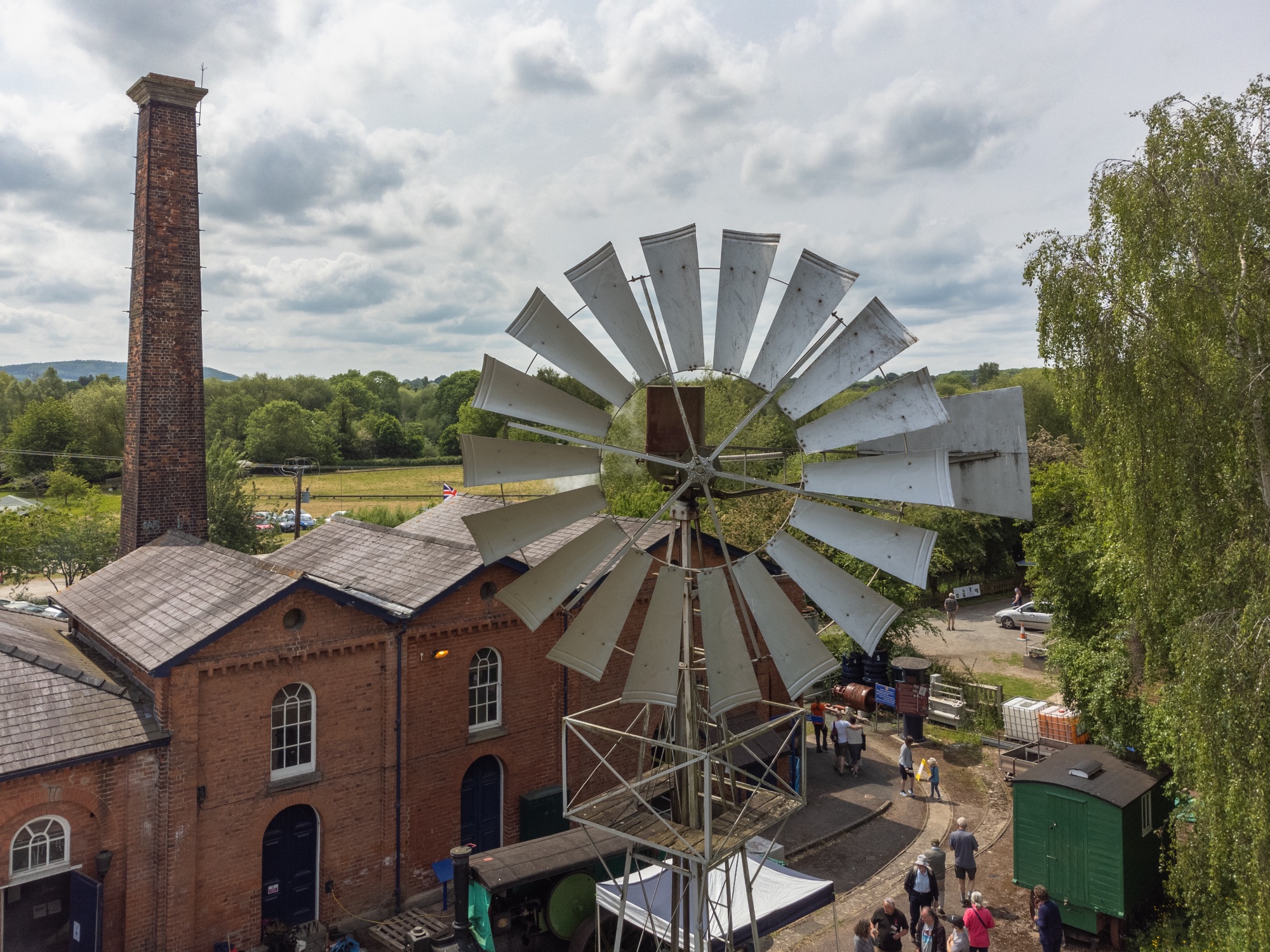
Climax-type Wind Pump - (1930)
Climax-type wind-powered pump Thomas & Sons of Worcester (Probably taken over by Stuarts & Lloyds Ltd) Wind-powered pump of the Climax-type installed at a farm in Bridge Sollers near Hereford to pump water from a borehole for domestic and farm purposes. Described as a self-oiling, variable stroke, enclosed mill head with self-aligning ball bearing turntable. Rescued from the farm in 2002 and refurbished and re-erected at the Museum by Penybryn Engineering of Hengoed the following year. Regrettably the phosphor bronze borehole pump could not be rescued and therefore another simple force pump has been substituted for demonstration purposes. Wheel diameter: 3.7 metres (12 feet) Tower height: 9.1 metres (30 feet) Donated by Mr IK Johnson of Bridge Sollers, Herefordshire
More information
Mather & Platt Two Stage Centrifugal Water Pump. - (1930)
Mather & Platt single-stage centrifugal pump Mather & Platt Ltd of Salford and Manchester Mather & Platt began manufacturing centrifugal pumps from about 1865 (the exact date has not been established as they were developing such pumps from 1858 onwards.) From 1909 the advantages of the split-casing design were appreciated for low-pressure use and for boiler-feed pumps. This example is a single-stage, split-casing pump. The two halves of the casing have been separated to show the impeller inside. Donated
More information
Bamford Sinle Cylinder Petrol Engine - (1930)
Single-cylinder petrol engine made by Bamford of Uttoxeter, forerunner of the better known JCB Excavator business. The history of Bamford Ltd starts in 1871 with the founding of the company by Henry Bamford and his son, Samuel. Until 1920, the company had only manufactured agricultural machinery but, in that year, they entered the stationary engine field. The company had recognised the demand for these engines to drive barn machinery, dairy appliances and sheep-shearing equipment that were now being used in ever increasing numbers.
More information
Tangye triple-throw vertical pump - (1930)
Tangye triple-throw vertical pump Tangye Ltd of Birmingham 3-cylinder vertical pump originally installed at Yarkhill pumping station in Herefordshire and powered by an electric motor. Now driven by a Lister CD single-cylinder diesel engine* (1943) via vee-belts. Pump No: 5616 Capacity: 16kL (3427 gallons) per hour at 70rpm Head: 90m (300 feet) Donated by Dwr Cymru Welsh Water
More information
Paterson Chloronome-type chlorinator - (1930)
Paterson Chloronome-type chlorinator Paterson of London On display is the absorption tower of an automatic type of chlorinating apparatus which varies the flow of chlorine proportionate to the flow of water. As chlorine is highly corrosive the tower is made of ceramic composition. Donated
More information
Ruston-Hornsby Single Cylinder Petrol Engine. - (1930)
Single-cylinder water-cooled 1½hp petrol engine used for pumping water from a well at Homelands Farm near Hereford. Typical of a small petrol engine used for water pumping on farms throughout Britain before, during, and after WW2. This engine completed service in 1960.
More information
Allen Two-Cylinder Vertical Diese Engine - (1932)
Allen twin-cylinder vertical diesel engine, David Brown gearbox and borehole pump WH Allen of Bedford Two-cylinder vertical diesel engine of modular construction, designed mainly for stationary purposes. This example is thought to be the only one of its date and type remaining in the UK. Used at Alton Court Waterworks, Ross-on-Wye, where it replaced the National Gas engine*. The diesel engine drove a 5-stage centrifugal borehole pump via a David Brown speed increasing and right-angle drive gear box. Both these items are also on display. Power: 60bhp Donated by Dwr Cymru Welsh Water
More information
Tangye 3-throw horizontal pump - (1932)
Tangye 3-throw horizontal pump Tangye Ltd of Birmingham 3-cylinder horizontal pump driven from the Tangye 97-litre horizontal diesel engine*. Pistons operate from a common crankshaft at 120o offset. The large flywheel on the engine smoothes the uneven running of the single-cylinder engine and transmits the drive via a manually-operated drum clutch. When engaged the drive speed is reduced by an enclosed double-helical gear train. Pump set installed at Milton Springs, Pembroke Dock. Donated by Dwr Cymru Welsh Water
More information
Tangye 97Litre Single Cylinder Diesel Engine and Triple Pump - (1932)
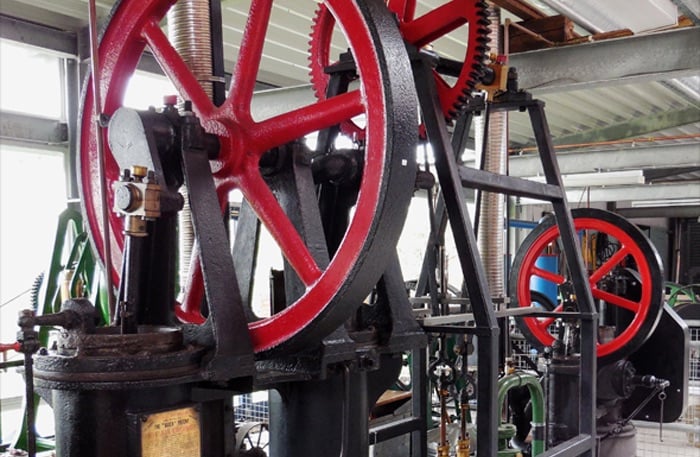
Tangye 97-litre single-cylinder horizontal diesel engine and triple-throw pumps Tangye Ltd of Birmingham Single-cylinder, horizontal, open-crank diesel engine designed for the Indian market. This example is one of only two known to have been installed in the UK and was used at Milton Springs to provide water for the Pembroke Dock area. It is coupled via a large flywheel, manual clutch and gear train to the crankshaft of a Tangye three-throw horizontal pump set*. It was rescued, re-installed and re-commissioned at the Museum in 1990. Thought to be a unique working example. Power: 86hp Speed: 220rpm Flywheel diameter: 2.6 metres (8.5 feet) Start up: compressed air at 300psi (20 atmospheres) Donated by Dwr Cymru Welsh Water
More information
Tangye Semi-Diesel Donkey Engine - (1932)
Tangye single-cylinder semi-diesel donkey engine Tangye Ltd of Birmingham Single-cylinder, vertical, semi-diesel engine driving a single-stage Tangye compressor. Semi-diesel engines require heat from an external source (flame) to ignite the fuel until the engine is thoroughly warm, whereupon the external source of heat can be removed. Engine and compressor installed at Milton Springs, Pembroke Dock, to provide compressed air to start the Tangye 97-litre diesel pumping engine*. Donated by Dwr Cymru Welsh Water
More information
1932 5_stage Submersible Centrifugal Borehole Pump - (1932)
This centrifugal submersible pump is a 5-stage machine from Alton Court Waterworks at Ross-on-Wye. It was installed some 80ft (24m) below the Allen diesel engine at the bottom of a 9in (225mm) diameter pipe – the rising main – with 2½in (60mm) diameter drive shaft rotating in the centre. Water entered through a strainer (not shown) in the bottom and passed through the pump, being increased in pressure at each impeller stage. The water was discharged at the top of the main via a bend, the drive shaft passing through a vertical watertight gland or seal. A Mitchell thrust bearing at the top of the shaft supported the substantial downward load exerted by the pump resulting from the pressure generated in delivering the water against the operating head of 300ft (90m.)
More information
Harland pump set: vertical electric motor and borehole pump - (1935)
Harland pump set: vertical electric motor and borehole pump Harland Engineering Co Ltd of Glasgow (now part of Weir Pumps Group) Vertical, centrifugal, spindle-driven borehole pump powered by a three-phase motor above ground level. One of two Harland pump sets originally installed at Balsdean Pumping Station, Rottingdean, Sussex. The other pump is on display at the Brede Steam Engine Society site near Hastings, Sussex. No data available Donated by Southern Water
More information
Gilbert, Gilkes & Gordon - (1937)
Gilbert, Gilkes & Gordon Francis-type turbine Gilbert, Gilkes & Gordon Ltd of Kendal Water reaction turbine of the Francis-type, installed at the Crooked Well pumping station at Kington, Herefordshire. A weir had been created on a tributary of the River Arrow to form a head of some 5 metres (16.5 feet) to drive the turbine. The output shaft carried a pinion which engaged with a crankshaft connected to triple-throw Warner pumps*. The power output of the turbine could be regulated by adjusting the angle of the guide vanes directing water onto the turbine rotor. Power output: 4hp Consumption: 5000 litres (1100 gallons) per minute Speed: 320rpm Donated by Herefordshire Water Board
More information
Warner triple pumps - (1937)
Warner triple pumps Robert Warner & Co Installed at the Crooked Well pumping station at Kington, Herefordshire, and driven by a Gilbert, Gilkes & Gordon Francis-type turbine* powered from a river weir. The triple-throw horizontal pumps are incomplete but sufficient remains to provide an understanding of the piston size and general layout. The pumping set provided the water supply for the market town of Kington. No data available Donated by Herefordshire Water Board
More information
Stirrup Pumps - (1938)
Stirrup pumps The stirrup pump was developed in 1938 from an earlier design to help extinguish incendiary bombs. The base of the hand-operated pump was placed in a bucket of water with one foot on the external support, hence the name stirrup pump. A hose 7.6 metres (25 ft) long was provided which had an adjustable nozzle to give either a jet or a spray. Single-acting hand-operated pumps (six on display by various manufacturers) Various donors
More information
Josep Evans Single Cylinder Double Acting Water Pump - (1938)
Joseph Evans single-cylinder double-acting open-crank pump Joseph Evans & Co of Wolverhampton Single-cylinder, double-acting, open-crank, horizontal water pump designed to be driven via five vee-belts from an electric motor. Originally installed at Kinwarton in Warwickshire and later on display at the offices of Severn Trent Water. At the Museum it has been converted to a hand-operated pump for children, and adults, to turn and appreciate just how hard pumping water really is. The system is run on closed water circulation. Donated by Severn Trent Water
More information
Mather & Platt Medivane 2-stage centrifugal pump - (1939)
Mather & Platt Medivane 2-stage centrifugal pump Mather & Platt Ltd of Salford and Manchester 2-stage centrifugal, split-case pump of the Medivane-type, originally installed at the Royal Ordnance Munitions Factory at Rotherwas in Hereford. Driven by a Blackstone EPV5, 5-cylinder diesel engine* via 11 vee-belts, to pump water from an adjacent reservoir in case of conflagration on site. Mather & Platt Ltd were taken over by Weir Pumps Ltd in the 1980s. Serial No: 44547 Type mark: 7/9 2STMEDIVANE Capacity: 5680 litres/minute (1250 gallons/minute) Working head: 100 metres (320 feet) Donated by Collins Engineering of Pontrilas
More information
Blackstone single-cylinder diesel donkey engine - (1939)
Blackstone single-cylinder diesel donkey engine Blackstone & Co of Stamford, Lincolnshire Small single-cylinder vertical diesel engine directly driving a single-stage compressor, installed at the Royal Ordnance Munitions Factory at Rotherwas in Hereford for starting the Blackstone EPV5, 5-cylinder diesel engine*. No data available Donated by Collins Engineering of Pontrilas
More information
Blackstone 11-Belt Drive. - (1939)
Drive to water pump
Full description of this artefact is pending.
More information
Wallace & Tiernan bell-jar chlorinator - (1939)
Wallace & Tiernan bell-jar chlorinator Wallace & Tiernan of London Apparatus used to add carefully-determined flow rates of aqueous chlorine solution at water-treatment works to kill bacteria. The equipment on display provided chlorination of the water supplies at Oswestry Waterworks in Shropshire. Donated
More information
Blackstone EPV 5-Cylinder Vertical Diesel Engine. - (1939)
Blackstone EPV5 5-cylinder diesel engine Blackstone & Co of Stamford, Lincolnshire 5-cylinder, vertical diesel engine of a type first made in 1935 and ceased production in 1950. This engine was installed at the Royal Ordnance Munitions Factory at Rotherwas in Hereford. It was housed in a windowless bunker, adjacent to a purpose built reservoir, to drive a Mather & Platt centrifugal pump* to provide water at high pressure for the site in case of conflagration. It is thought to be the only example working in the UK. Blackstone & Co went through many amalgamations and the trademark is held now by a finance company. Engine No: EPV5-45191 Power: 170bhp Speed: 600rpm Start up: compressed air at 250psi (17 atmospheres) Donated by Collins Engineering of Pontrilas
More information
Compressed Air Starting System - (1939)
The Blackstone EPV5 5-cylinder diesel engine requires compressed air to start up. The system installed in 1939, and now at the Museum, comprised a common air receiver fed by two alternative compressors. A Blackstone single-cylinder diesel engine with hand-crank start powered the first compressor whilst an electric motor drove the second via vee-belts. It is the electric motor system which is now in use, as the compressor powered by the diesel engine has a visibly repaired crack in its cooling water jacket.
More information
1940
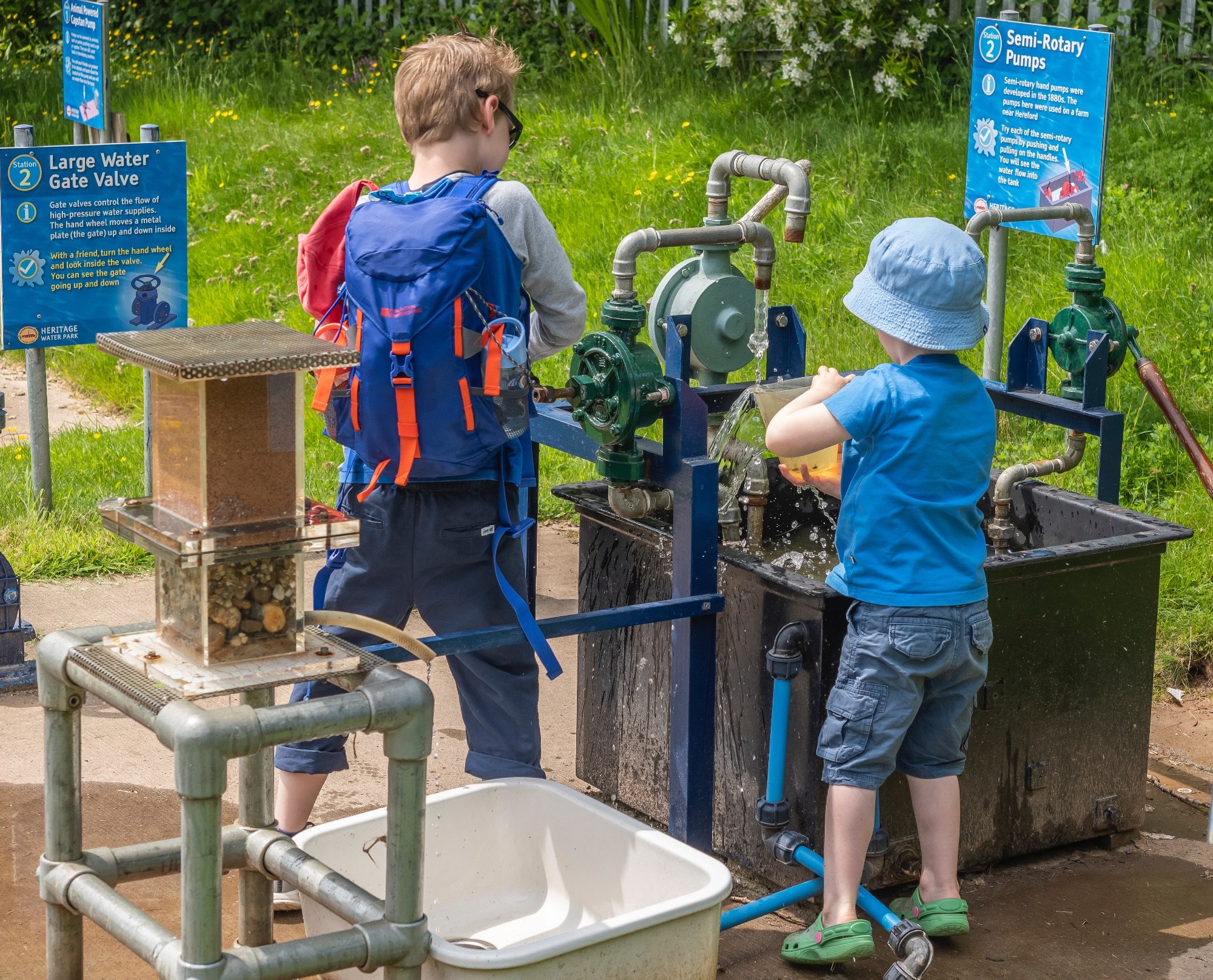
Semi-Rotary Water Pump - (1940)
No description
More information
Coventry Climax Portable Fire Tender. - (1941)
Coventry Climax fire tender Coventry Climax Ltd of Coventry Fire tender of the Godiva-type which could be man-handled into position and used extensively on airfields, in factories and for protecting large municipal buildings throughout WW2. 4-cylinder petrol engine driving a single-stage centrifugal pump primed from the engine exhaust pressure. Fitted with hoses and nozzles. The Godiva fire tender was developed in 1937. Donated
More information
Lister Single Cylinder D-type Petrol Engine - (1942)
Lister D single-cylinder petrol engine RA Lister & Co of Dursley, Gloucestershire Single-cylinder vertical petrol engine. RA Lister began the manufacture of petrol engines in 1909. Later, the D-type became hugely popular and the company manufactured and shipped many thousands all over the world. Little is known of the original use of this example. It is now being used to power Tangye twin horizontal pumps*. Engine No: D309 Donated by Dwr Cymru Welsh Water
More information
Lister CD Single Cylinder Diesel Engine - (1943)
Lister CD single cylinder diesel engine RA Lister & Co of Dursley, Gloucestershire Single-cylinder vertical diesel engine. Robert Ashton Lister set up the company at Dursley in 1867 manufacturing a wide range of agricultural machinery. Diesel engine manufacture began in 1929. Little is known about the original use of this engine. Engines and pumps of all makes and descriptions were mixed and matched between the wars and during the wars. In this spirit the engine is now being used to power Tangye triple-throw vertical pumps*. Engine No: 359316 Name plate spec: CD 23/18
More information
1950
Crompton-Parkinson Electric Motor. - (1950)
Crompton-Parkinson motor and Pulsometer spindle-driven centrifugal pump Crompton-Parkinson Ltd (motor); Pulsometer Pump Co (pump) Three-phase electric motor driving, via a spindle, a submersible centrifugal pump. This pumping set was installed originally on site and pumped water for Hereford from 1950 until 1977. It used the shaft and sump originally dug in the 1860s and fed from the River Wye. The electric motor was mounted at floor level driving the pump below water level via a spindle some 6 metres (20 feet) long. It pumped raw water to the treatment works on the hill behind the pumping station. Now displayed with the pump impeller visible and rotating at slow speed for demonstration purposes. Electric motor output power: 63kW (85hp) Pump capacity: 4.5Ml (1 million gallons) per 12 hours In situ
More information
Water Level Instrument. - (1950)
With the need to know the water levels of the remote bodies of water being pumped from and pumped to, the public telephone system was used to transmit the information. In this case a constant-voltage source is used in conjunction with a potentiometer system, often known as a resolver. A float on the surface of the water is used to rotate the resolver and thus create an electrical signal in the system which is proportional to the height of the water surface. This information can then be transmitted to some remote location, such as the pumping station, and displayed on a meter calibrated as water level.
More information
Tangye pump set - PELAPONE - (1955)
Tangye pump set: Pelapone 4-cylinder diesel engine and centrifugal pump Tangye badged. Engine by Pelapone Ltd of Derby. Pump manufacturer not known. PELAPONE stands for Prudence Light And Power - Our New Engine. After WW2, Tangye’s of Birmingham were bringing together engines and pumps of various manufacturers and shipping the complete sets as Tangye pumps. This example is one of a complementary pair of pump sets installed at RAF Hullavington in Wiltshire for fire-fighting purposes. The engine drove the 4-stage centrifugal pump through a speed decreasing gearbox. Engine: Pelapone-Ricardo 4-cylinder diesel Engine No: 5414981 Power: 55bhp Speed: 1500rpm Donated by Defence Estates on the advice of English Heritage and North Wiltshire District Council
More information
Tangye pump set: Electric Construction Co motor and centrifu - (1955)
Tangye pump set: Electric Construction Co motor and centrifugal pump Tangye badged. Motor by Electric Construction Co of Wolverhampton. Pump manufacturer not known. After WW2, Tangye’s of Birmingham were bringing together engines and pumps of various manufacturers and shipping the complete sets as Tangye pumps. This example is one of a complementary pair of pump sets installed at RAF Hullavington in Wiltshire for fire-fighting purposes. The motor was manufactured by the Electric Construction Co, one of the first companies devoted to electrical engineering as far back as 1882. The motor powered the 3-stage centrifugal pump directly. Motor No: 114255 Spec: 3-phase, 42bhp, 400V, 57 Amps/phase Speed: 1450 @ 50Hz Donated by Defence Estates on the advice of English Heritage and North Wiltshire District Council
More information
Electric Construction Co. Electric Motor. - (1955)
Motor driving 4-stage centrifugal pump.
Full description of this artefact is pending.
More information
1960
Lister Diesel Engine Driven 2-foot Guage Locomotive. - (1962)
Lister diesel locomotive and trucks working on 2 foot gauge track. RA Lister & Co of Dursley, Gloucestershire Lister diesel-engine powered open frame locomotive of the type used at water treatment works and manufacturers’ yards. No data available Donated by Painter Bros Ltd of Hereford
More information
Parkinson-Cowan ‘Teletalk’ water level annunciator - (1962)
Parkinson-Cowan Ltd Water level was measured with a weighted float and cord actuating a pen recorder. This also created a voltage between 0-50V proportional to water level to drive a servo motor, which moved a playback head along the length of a magnetic recording drum. The level of voltage determined the position of the servo and selected a particular pre-recorded track. The drum was then rotated by another motor and the recorded announcement transmitted via a cable to the receiving telephone. Installed at Bewdley in Worcestershire at a gauging station on the River Severn. Apparatus includes: GET11 transistors (some of the earliest made in UK); standard GPO relays Donated by Severn Trent Water
More information
1970
Rotork Motorised Water Valve. - (1970)
Rotork was established by Jeremy Fry, second son of the last Fry family chairman of the famous chocolate company. Rotork Ltd designs, manufactures and supports a range of industrial actuators. An actuator being a mechanism that controls the opening and closing of a valve. An ordinary tap handle is a type of actuator, which when turned opens or closes a valve connected to a water pipe. Rotork's actuators are much more technologically advanced than a household tap, though, and they are used as major control elements in oil and gas refineries and pipelines, water distribution systems, and sewage and effluent treatment plants.
More information
Hartley & Sugden package boiler - (1972)
Hartley & Sugden package boiler Hartley & Sugden Ltd of Halifax This automatic oil-fired package boiler was originally installed for heating greenhouses at a plant nursery in Stratford-upon-Avon. It had been abandoned and was rescued by the Museum in 1992. Having been positioned, piped and safety tested, it was re-commissioned at the Museum in 1994 and connected to the steam distribution system. Whilst the pressure was lower than the output of the Lancashire boiler it was found to be satisfactory for operating the four main steam engines and two boiler-feed pumps at the Museum simultaneously. With a NuWay oil-burner it is considerably more efficient and economical than the Lancashire boiler*, and of course much easier and quicker to bring up to pressure from cold. Rated output: 1360kg/h (3000lb/h) Pressure: 55psi (3.7 atmospheres) Fuel: 35second heating oil Water capacity: 4755 litres (1045 gallons) Rescued by the Museum
More information
Pleuger centrifugal borehole pump and motor. - (1973)
Pleuger centrifugal borehole pump and motor Pleuger Pumps, founded in 1929, now part of the Flowserve group, specialised in water-filled motors to power their submersible pumps. The example on display dates from 1974 but is broadly the same as contemporary Pleuger submersible borehole pumps. It was installed originally at the Broomy Hill Lower Pumping Station in Hereford (adjacent to the Museum.) The pumping station was constructed following the privatisation of water in the UK. The then Welsh National Water Development Authority soon became Welsh Water and later Dwr Cymru Welsh Water. Although Herefordshire is in England the catchment area of the River Wye determined the natural boundaries of the new regional water undertaking. Four Pleuger pumps were installed in the pumping station. Pump capacity: 13.6Ml (3 million gallons) of water per day Donated by Dwr Cymru Welsh Water
More information
1980
Grundfoss Boiler Feed Water Pump. - (1980)
As a boiler converts water into steam, the water has to be replaced against the boiler pressure. This is the job of a boiler-feed pump. Such pumps have to be designed to cover a wide range of special requirements for scale, pressure, temperature, inlet conditions, and more. Grundfos offers a range of rugged pumps that can meet such demands. The model on display is a centrifugal pump designed to handle high temperatures without damaging the shaft seals.
More information
Haywrd-Tyler Centrifugal Borehole Pump. - (1980)
Hayward-Tyler centrifugal borehole pumps and motors Hayward-Tyler Ltd of Luton The company was founded in 1815 manufacturing mineral water machinery, hydraulic presses, water closets and general plumbing accessories. Prior to WW1 the company began to develop submersible pumps and motors. The examples on display are of the Sumo-type being integrated high-efficiency submersible centrifugal pump sets. They were originally installed at Vowchurch boreholes in Herefordshire. No data available Donated by Dwr Cymru Welsh Water
More information
Grundfoss Centriugal Stainless Steel Submersible Borehole Pu - (1980)
Paul Jensen founded Grundfos on the Jutland peninsula in Denmark in 1945. His initial orders were for agricultural pumps in the difficult post-war years. The first centrifugal pumps were developed in the 1950s and Grundfos specialised in stainless-steel construction. Borehole pumps have to work very hard in difficult conditions, with minimal downtime. In cost terms the price to raise and re-install a borehole pump following breakdown can be many times the cost of repair or even that of a new pump. Applications include raw water supplies, irrigation systems, groundwater lowering and many others. Where the liquid is aggressive, stainless steel comes into its own, as in the example on display.
More information
2000
Easthall Visitor Centre and Southall Engine Gallery - 2006 - (2006)
Easthall Visitor Centre and Southall Engine Gallery In the 1990s the Waterworks Museum was short of covered space to house additional items. Furthermore it had only a temporary visitor centre, no education space and limited facilities for engineering work. At the turn of the millennium the Trustees were informed that the main building was being placed on the English Heritage Register of Buildings at Risk. Bold steps were required to attempt to integrate all the requirements into a single very large building project. With the assistance of English Heritage an outline plan emerged and funding was raised from the Heritage Lottery Fund, Dwr Cymru Welsh Water, English Heritage and the Southall Trust. Construction began in 2005 by Speller-Metcalf Ltd of Malvern and was completed in 2006, with official hand-over in June of that year. All the internal services, fittings and fixtures were undertaken by the Museum’s own volunteer engineers. The new structure, whilst tightly adjacent to the main Victorian Museum building, is completely separate save for the rain seal between the two. It is constructed in steel and glass on deep-piled foundations and provides a superb open-plan Visitor Centre, education space for a large class, a new gallery for smaller engines, and an excellent workshop. Design architects: RRA Ltd of Hereford Executive architects: Lett & Sweetland of Worcester Construction: Speller-Metcalf Ltd of Malvern Funding: Heritage Lottery Fund; Dwr Cymru Welsh Water; English Heritage; Southall Trust
More information
Rotherwas Engine House - 2007 - (2007)
Rotherwas Engine House When the Trustees of the Waterworks Museum first heard of the Blackstone EPV5 engine* and Mather & Platt pump* lying derelict at Rotherwas, Hereford, it was realised that a rescue would require a new building to house them. The donors of the engine and pump, Collins Engineering Ltd, agreed not only to move the artefacts to the Museum site but would also design and construct a new building at cost price. Building work began in 2006 and was completed by the spring of 2007. The artefacts were transported, installed, renovated to working order and the building officially opened in September 2007. It includes not only the engine and pump in an authentic setting but also a permanent exhibition devoted to Hereford in WW2, with emphasis on the Royal Ordnance Munitions Factory at Rotherwas. Other items from the Museum’s back-stock relating to WW2 have been sited here too, including two pump sets linking Lister engines* to Tangye pumps*. The building is in red-brick construction and built partially into a hillside, redolent of the WW2 bunker which housed the engine and pump originally. The internal services in the building were installed by Museum volunteer engineers. Design and construction: Collins Engineering Ltd of Pontrilas Funding: Heritage Lottery Fund (Your Heritage strand); Southall Trust
More information
Site Design & Development DOM Computer Services.
All Rights Reserved 2007
Content Waterworks Museum - Hereford
 
This website is owned and published by The Waterworks Museum - Hereford, a charitable trust, a company limited by guarantee and a registered museum whose registered company address is Waterworks Museum - Hereford Ltd, The Hereford Waterworks, Broomy Hill, Hereford, HR4 0LJ
Registered Charity No: 515866. Registered Company No: 1820495